#Private Detectives in Morocco: How an Investigation Actually Works
The use of a private investigator is not usually a light decision. Often there is a doubt, an unusual situation, difficult to verify information or a problem that cannot be addressed by ordinary means.
But between suspicion and investigation, there is a significant difference.
A private investigation is not simply "following someone" or seeking information. It begins with an understanding of the situation, a precise definition of what needs to be verified and the choice of a method adapted to the context.
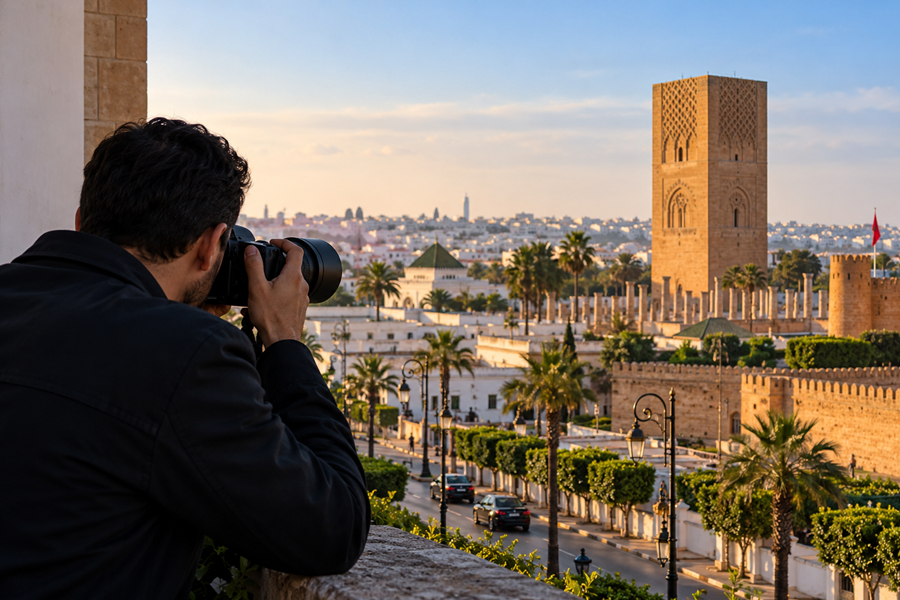
In Morocco, this dimension is particularly important. An investigation conducted in Casablanca does not necessarily present the same constraints as a mission to Tangier, Marrakech, Fès, Agadir or a rural area. The terrain, distances, urban environment, social habits and local peculiarities can change the way a mission needs to be prepared.
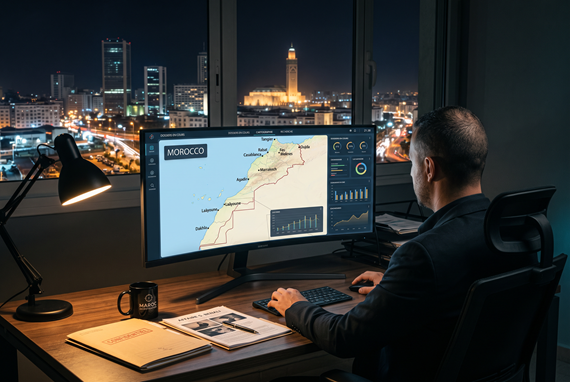
It is in this reality that the work of Maroc Investigation, a private detective agency working in Morocco with both individuals and companies.
Really understand the work of a private detective
An investigation begins with a question
When a client contacts a private investigator, he or she does not always have all the necessary elements to understand a situation.
He may have a suspicion about an individual, find unusual behaviors, seek to verify information or be confronted with difficulty in his business.
The role of the investigator is not simply to confirm what the client already thinks.
He must first understand what the customer is really looking to check.
This distinction is essential.
Suspicion is not evidence.
An investigation is precisely one of searching, verifying and documenting elements that would enable the question to be answered as objectively as possible.
An investigation does not always follow the same scenario
There is not a single method applicable to all situations.
Depending on the nature of the mission, the investigation may require different approaches: information retrieval, verification, observation, surveillance, professional or commercial research, search for people or analysis of a particular situation.
The first step is therefore to determine the mission's objectives.
What are we looking for to know?
What information is already available?
What elements still need to be checked?
What means can be used within the applicable framework?
These questions allow a coherent mission to be built, rather than unnecessarily increasing the number of approaches.
From information to the verifiable element
Isolated information does not always have the same value as a cross-referenced and documented element.
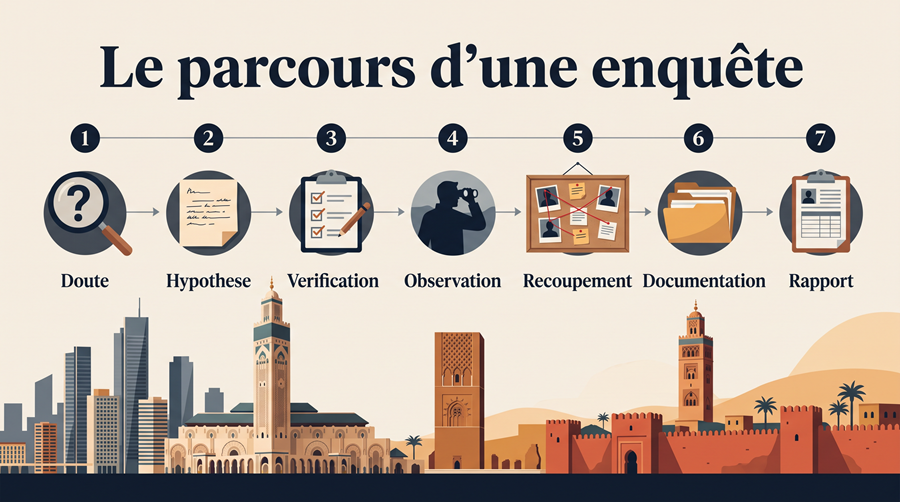
This is why a serious investigation is based on several steps:
Information → hypothesis → verification → observation → cross-checking → documentation → report
The goal is not to produce a story that confirms an intuition.
The objective is to look for elements that will enable the client to better understand the situation in which his request is made.
Suspicion is not evidence
This distinction deserves to be recalled because it is one of the main difficulties encountered in private investigations.
A person may be convinced that behaviour is suspicious. A company may suspect a leak of information. A leader can see irregularities without knowing precisely their origin.
But personal conviction is not necessarily enough to establish the facts.
The investigation work therefore consists of taking a distance from the initial hypothesis.
This also means that an investigation may sometimes lead to a result different from the one originally conceived.
This is precisely what gives her interest in a professional investigation: seek to check rather than confirm.
Investigating in Morocco: a land with multiple realities
Morocco is not a uniform ground.
Geography, urban density, distances, infrastructure, local habits and social environments can vary considerably from region to region.
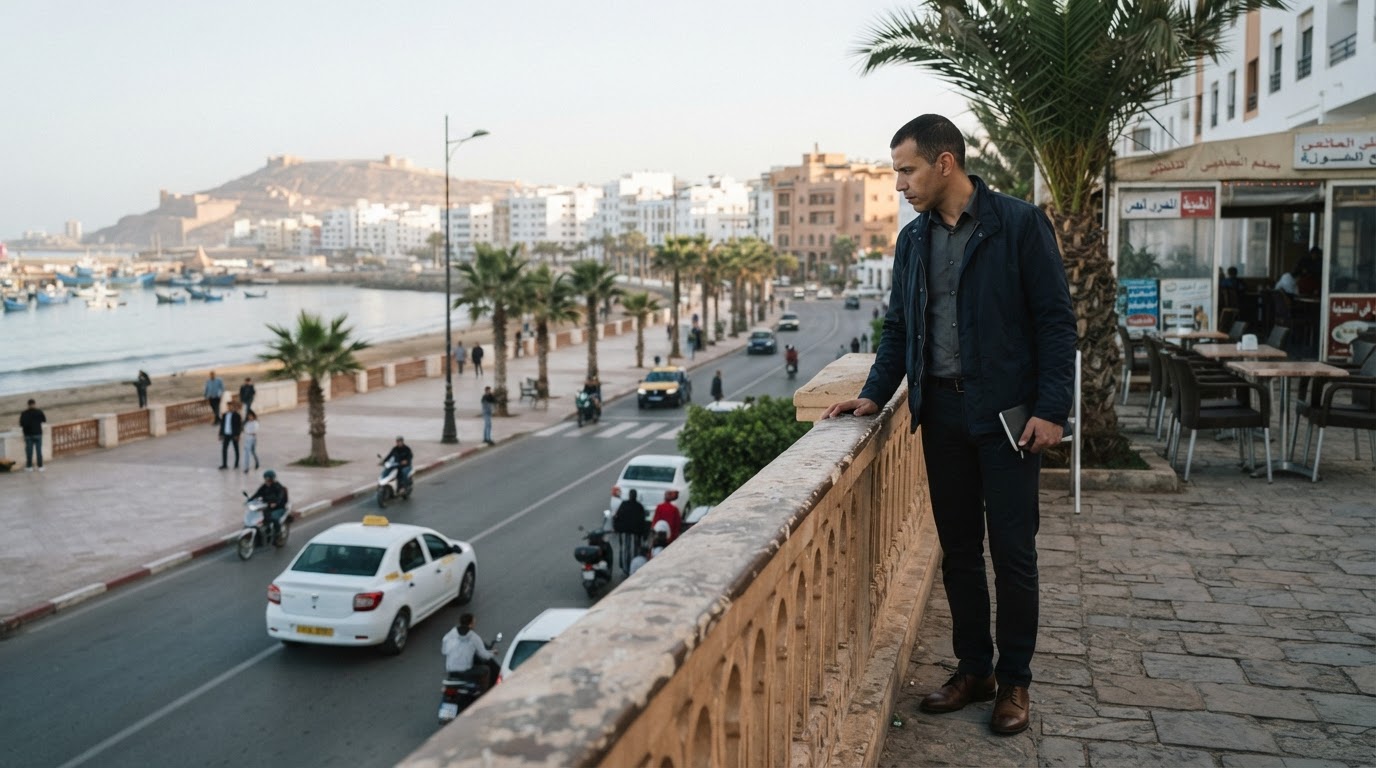
A mission to Casablanca, for example, can take place in a dense urban environment characterized by high traffic, high mobility and a wide variety of neighbourhoods and activities.
Conversely, a survey conducted in a small town, rural area or region with significant distances may present completely different constraints.
Northern Morocco
Tangiers, Tetouan, Larache, Chefchaouen and other northern territories have their own geographical and social characteristics.
The relief, the configuration of cities, the movements between urban and rural areas and the peculiarities of certain territories can influence the preparation of a mission.
Knowledge of the field then becomes an important part of the organization of the survey.
The Centre
The Casablanca-Rabat-Kenitra axis and the surrounding regions have a highly urbanised environment and significant economic activity.
In particular, professional issues can take place in very different environments: offices, industrial areas, shops, residential areas or peripheral areas.
Traffic, displacement and population density are also parameters to be taken into account.
The South and the more remote regions
Marrakech, Agadir, Ouarzazate and the territories further south present other realities.
Distances can be large, urban areas can be separated by vast spaces and conditions of intervention may differ significantly from those encountered in the major cities of the Centre.
A mission must therefore be prepared taking into account the geographical reality of the field.
Knowledge of local habits also counts
A survey never takes place in a purely theoretical environment.
Neighbourhood life, proximity relationships, social habits, location configuration and cultural peculiarities can influence how a situation needs to be understood.
It is not about applying clichés to a region or population.
It is simply a question of recognizing that a discreet intervention must be adapted to its environment.
An efficient method in a very dense area of Casablanca will not necessarily be suitable for a small town or rural area.
This is one of the reasons why field experience may be particularly important in a private investigation in Morocco.
Why a survey cannot be standardised
Two applications that appear to be similar may require very different means.
Let's take two surveillance missions.
The first takes place in a large agglomeration, with many movements and a high traffic density.
The second concerns a less dense area, where people know each other more and travel is much more predictable.
The objective of the investigation may be similar.
The context is not.
The preparation must therefore take into account the location, duration envisaged, movements, nature of demand and information available at the outset.
It is also for this reason that it is difficult to seriously determine the cost or duration of an investigation before you have fully understood the mission.
How to choose a private detective in Morocco?
The choice of a professional should not be based solely on an advertised price or a promise of results.
Before assigning a mission, several questions deserve to be asked.
Did the professional really understand your problem?
A first serious exchange should allow for an understanding of the situation before proposing intervention.
A professional must be able to clearly reformulate the mission's objective.
Is it transparent about its methods and limits?
Beware of absolute promises.
A serious investigation should not be presented as a method to "know everything" or obtain any information.
Transparency on what can be done, as well as on what cannot be done, is an important element in the choice of a professional.
Did he know the terrain?
An agency operating in several regions must be able to take into account the differences between the environments in which it operates.
Knowledge of cities, displacements and local realities can have an impact on mission preparation.
How is confidentiality treated?
Requests to a private investigator may concern particularly sensitive information.
It is therefore legitimate to ask how the exchanges, information provided and the results of the investigation are handled.
How is the mission defined?
Before starting, the client must understand as much as possible:
- the objective of the mission;
- the means envisaged;
- the conditions of intervention;
- any limits;
- the procedures for returning the results.
What does the client get at the end?
An investigation should not simply end in an informal conversation.
Depending on the nature of the mission, the items collected can be organized and presented in a report that allows the client to understand the findings made.
The approach of Maroc Investigation
Maroc Investigation accompanying individuals and companies who wish to have a situation verified which requires a private investigation.
Each request begins with an exchange to understand the context and purpose sought.
The mission is then defined according to its nature, its environment and the means required.
The intervention may concern Casablanca, Rabat, Marrakech, Fès, Tangier or other cities and regions of Morocco.
The aim is not to systematically propose the same method to each client, but to adapt the approach to the situation encountered.
Confidentiality, field understanding and the search for verifiable information are essential elements of this approach.