#Private Investigations in Morocco: What Evidence May Be Admissible in Court?
A report by private detective Can it be used before a Moroccan court? Yes, evidence gathered during a private investigation may be presented in court proceedings. However, their admissibility is not automatic: it depends in particular on the nature of the dispute, the conditions for obtaining the information and the applicable rules of evidence.
An essential distinction must be made between the reliability of information, its legal admissibility and its probative force.
Does accurate information necessarily constitute admissible evidence?
A photograph, testimony or document may reveal a real fact without sufficient legal proof.
Take the example of a Moroccan company that suspects a former employee to hijack its clientele.
A photograph showing this co-worker with a client can confirm that a meeting took place. It alone does not prove the existence of a commercial hijacking.
The question is therefore not only whether the information is genuine, but also what it actually allows to be established.
Evidence may be admissible without being sufficient to convince the court.
This distinction is fundamental in any investigation aimed at clarifying a dispute.
How do conditions of collection influence the admissibility of evidence?
The origin of the information collected is an essential point.
A legally obtained document, an observation made under lawful conditions or information from a public source do not raise the same issues as a private exchange recovered without authorization.
In Morocco, Law No. 09-08 regulates in particular the processing of personal data and imposes requirements for legality, purpose and proportionality.
The collection of information in an investigation must therefore respect the rights of the persons concerned and the applicable rules.
The preservation of the elements also deserves special attention: a photograph without context, an incomplete document or a file whose origin is uncertain can be contested.
For this reason, a rigorous investigation should distinguish between direct observations, documents consulted and statements collected, without presenting an assumption as an established fact.
What value can a Moroccan judge attach to a private detective report?
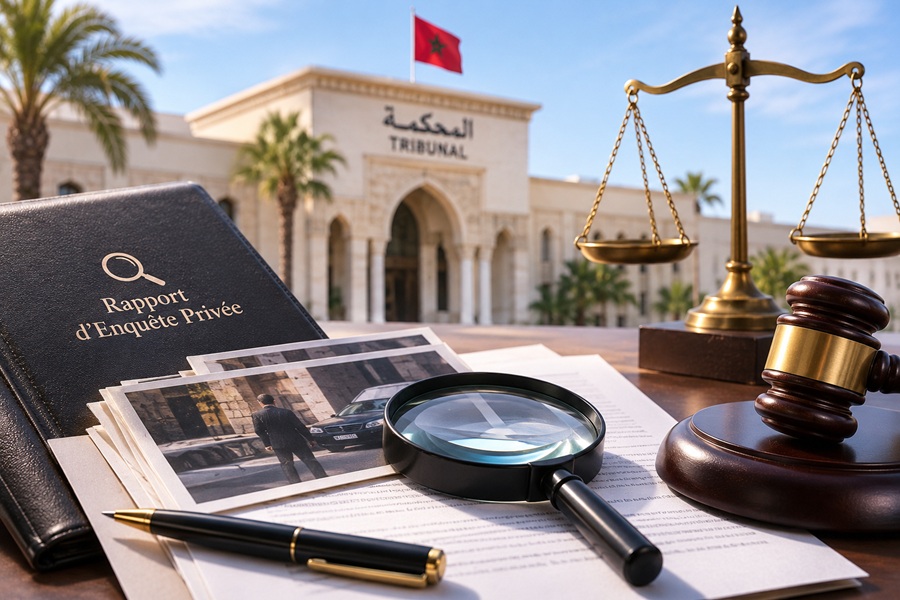
A private investigation report can help document a situation, present a chronology or reconcile several factual elements.
However, it does not automatically have the same scope as a finding made by a competent authority or an expert opinion ordered by a court.
The Moroccan Code of Civil Procedure provides for investigative measures, including expertise, investigation and site visits, which fall within a specific judicial framework.
A private report should therefore be distinguished from these official measures.
Its value depends in particular on its content, the accompanying documents, any disputes and the assessment of the competent court.
The role of the private investigator is to establish and document facts, not determine their judicial value.
Why prepare the investigation with a lawyer?
When an investigation is envisaged in the context of a trial, it is preferable to define from the outset the facts to be established and the limits of permitted searches.
The lawyer may assess the evidentiary requirements specific to the dispute, while the private investigator intervenes in the search and verification of information relevant to his or her mission.
This complementarity avoids unnecessary investigations or elements that are difficult to exploit legally.
At Maroc InvestigationOur approach is to focus on factual, documented and legally sound research, without promising that an item collected will necessarily be admitted or retained by a court.
A private inquiry that is useful to the justice system is not the one that accumulates the most information, but the one that enables relevant facts to be established by lawful and verifiable means.